Countertop Edge Profiles: Appearance, Use and Cost Questions
Compare countertop edge profiles by appearance, exposed edges, daily use and fabrication scope. Ask the right cost questions before approving your design.

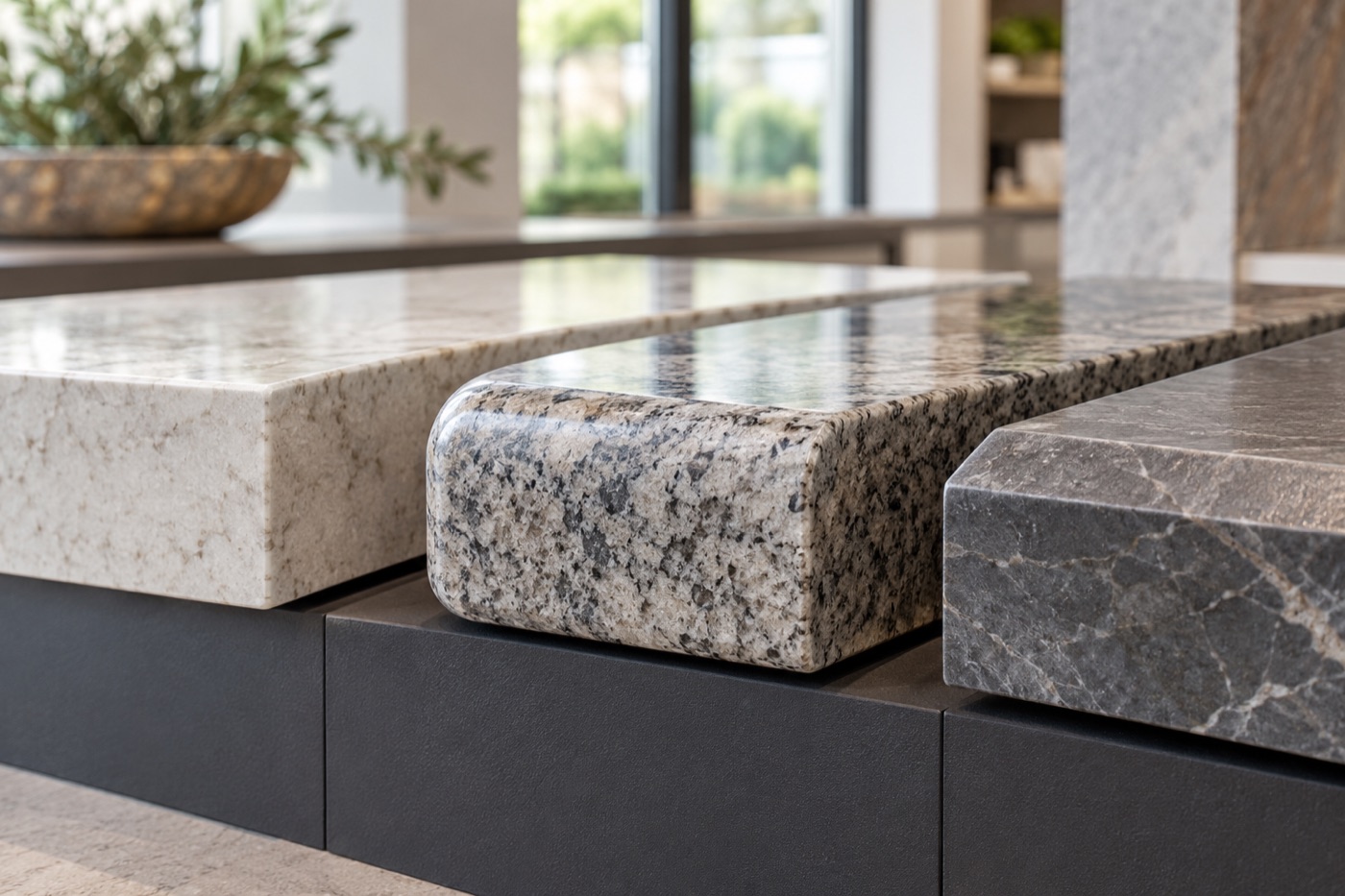
Countertop edge profiles influence both the visual weight of a surface and its fabrication details. An edge is a small feature repeated around a large area, so choose from a physical profile sample and a defined quote rather than a front-facing kitchen photograph alone.
Countertop edge profiles: start with a physical sample
Names such as eased, beveled or rounded describe broad directions, but suppliers may use labels differently. Ask to see the profile offered and confirm how it will be made in your selected material and thickness. The sample should clarify both appearance and the feel of the finished edge.
Look at the edge beside the cabinet door. A restrained profile may work well with detailed cabinetry; a more decorative profile may be intentional in a traditional design. There is no need to select a complex edge simply because the material is expensive.
Identify every exposed edge
Mark the countertop drawing to show which edges are visible and which meet a wall or another surface. Include island ends, seating areas and any separate vanity top. Confirm whether each area uses the same profile.
Waterfall ends and built-up-looking edges require their own discussion. A thick-looking front does not necessarily mean the entire slab has that thickness. Ask for a clear explanation of the construction and the resulting appearance at corners and ends.
Discuss practical use
Think about the positions where people stand, sit and move past the counter. Show the fabricator any concern about a projecting corner or a tight circulation area. Edge and corner decisions should be compatible with the material, layout and intended use rather than selected independently.
Do not assume any profile makes a countertop unbreakable. Request the appropriate care guidance and ask how visible joints or repairs would be handled if damage occurred later.
Compare the cost as an option
Ask for your preferred profile and the included alternative to be shown separately on the quote. Confirm which edges receive the upgrade and whether the price covers the entire project. That makes the difference understandable and prevents a partial-edge assumption from becoming a surprise.
Before approving fabrication, check: – Profile name and a matching sample or drawing. – Material and thickness. – Treatment of exposed ends and corners. – Any built-up or mitered appearance. – Whether the same detail applies to backsplash and other pieces.
Review countertop cost factors and shortlist materials in the countertop collection. Ask TR Granite about edge options for your selection; availability and suitability depend on the specific material and project.