Quartz vs Granite Countertops: Which Fits Your Kitchen?
Compare quartz vs granite countertops by appearance, care, heat precautions and installed scope. Use a practical checklist to choose for your kitchen.


Quartz vs granite countertops is a choice about your kitchen habits, design preferences and the exact material available—not a contest with one universal winner. Both can work well in a kitchen, but their appearance, product-specific care requirements and selection process differ.
Start with three questions: do you want a controlled pattern or natural variation, how do you use the kitchen every day, and which complete installed design fits your budget?
Quartz vs granite countertops: the basic difference
Engineered quartz is a manufactured surface containing mineral material and binders. Granite is natural stone cut into slabs. That distinction affects how you select the surface: with quartz, identify the exact manufacturer’s design and finish; with granite, inspect the actual slabs available for the job.
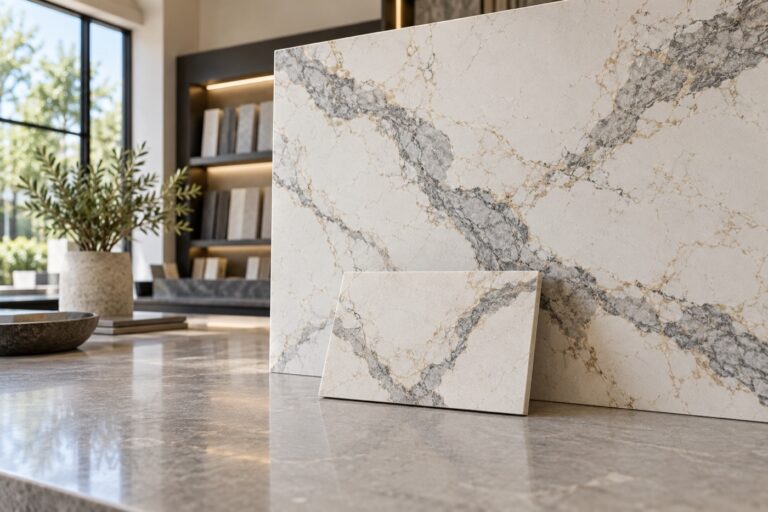
A small sample is useful for color coordination, but it does not show a whole island. Large veins, mineral concentrations and repeated design elements become easier to judge at slab scale. Ask to see the material you are actually approving and discuss how it will be arranged.
Compare the choices that matter to you
| Priority | Quartz | Granite |
|---|---|---|
| A consistent design direction | Manufactured collections can make it easier to target a particular background and pattern. | Natural movement varies between slabs; the selected slab is central to the design. |
| Care planning | Follow the exact brand’s cleaning and heat guidance. | Ask about the selected stone’s finish, treatment and sealing needs. |
| Visual selection | Check the full design, finish and any production variation. | Review the actual slab, including features near proposed cutouts. |
| Budget | Compare a complete installed quote for a named product. | Compare a complete installed quote for the selected stone. |
Decide how much natural variation you enjoy
If a calm white background is the first priority, start by comparing several quartz designs under your kitchen lighting. If you enjoy irregular mineral movement and a surface that differs from the next slab, granite may be the more appealing starting point. Neither description guarantees that every product in that category will suit your room.
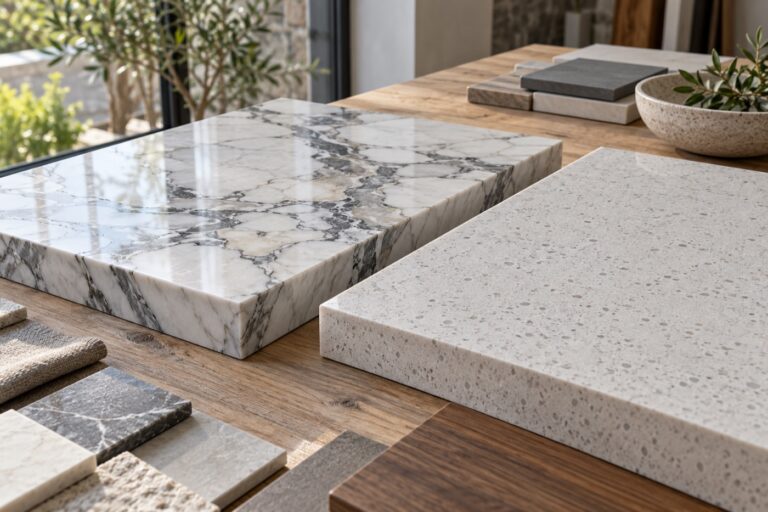
Place samples beside your cabinet door, flooring and backsplash. View them in daylight and under the lights you use at night. A color that seems neutral on a screen may look warmer or cooler next to your cabinets. Keep the final shortlist small enough that you can explain why each option belongs on it.
Understand care without the mar keting shortcuts
For example, MSI’s Q care guidance says Q does not require sealing and calls for protection from hot cookware and heat-generating appliances. Use that product’s instructions rather than treating quartz as heatproof.
For granite, sealing is not an automatic annual rule for every slab. The Natural Stone Institute’s sealing guidance explains that the benefit depends on the stone and treatment. Ask your fabricator for a care plan specific to your selection.
Whatever you choose, make protective habits convenient. Reserve a place for a cutting board and trivets near the cooking zone, and keep the approved cleaner where it is easy to reach. This is more useful than choosing a material on the assumption that it cannot be damaged.
Compare the same kitchen, not two headline prices
Ask for both options with the same layout, thickness, edge, sink configuration and removal scope. Otherwise a price difference may reflect the fabrication package rather than the material. Include any island overhang, backsplash detail or pattern-matching request in both estimates.
If one option is beyond budget, ask which design decision drives the difference. A different color, edge or layout may change the total without changing the material category.
A short decision checklist
- Choose quartz first if a particular manufactured pattern and its care routine match your priorities.
- Choose granite first if reviewing and selecting a naturally varied slab is part of the appeal.
- Reconsider either shortlist if the actual slab or sample conflicts with your cabinets.
- Request written care instructions and an itemized scope before making the final choice.
Browse TR Granite’s quartz countertops and granite countertops. For a comparison based on your kitchen, send the team your photos and approximate layout. The best choice is the one whose appearance, responsibilities and full project cost you understand.
Questions about quartz vs granite countertops
Which material is always less expensive?
Neither category is always the lower-cost choice. Compare named selections using the same kitchen drawing, edge profile, sink opening and installation scope. The slab layout and fabrication details can change the result. A comparison between unrelated headline prices does not establish which option costs less for your project.
Is a small sample enough to make the final decision?
Use a sample to compare undertones beside your cabinet finish, but review the larger pattern before approval. Ask what represents the actual material being supplied and discuss visible areas, cutouts and seams with the fabricator. This matters especially when an island is intended to show a prominent vein or natural feature.